Showing posts with label space race history. Show all posts
Watching the Space Race: A Better Engineer than Economist
Posted by
Karina Fabian
|
Labels:
going to Mars,
space race history,
von braun's Mars mission,
walt staples,
werhner von braun
by Walt Staples
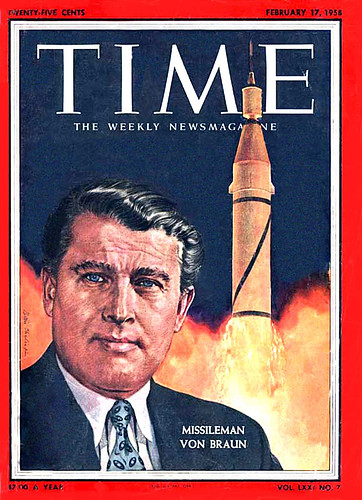
The face of America's space effort from early on was Dr. Wernher von Braun. In the mid-to-late 50s, we kids became aware of him and indulged in some harmless hero worship. I first saw him on Walt Disney's “Disneyland” TV show, when von Braun appeared in “Disney's Man in Space” episodes (“Man in Space”--spring 1955—and “Man and the Moon”--Christmas 1955). He had everything going for him that NASA could ask for; good looks, a slight German accent, a comfortable speaking style, and the ability to make you believe that manned space flight was just around the corner. This was increased by the release of his movie biography in 1960, “I Aim at the Stars,” in which he's portrayed by the guy who played the honorable U-Boat skipper opposite Robert Mitchum in “The Enemy Below” (Curt Jurgens).
Half a century later, feelings about von Braun are rather more mixed. One of the problems with being an adult is that your heroes become real people having the warts with which we're all prone. Like most of us, he had a history—in his case, one NASA's PR folks would have cringed over if it had been noised around at the time. Whether there was guilt or innocence, I'll let the final Arbiter decide. Instead, there's von Braun and his vision and the fact that he was no economist.
Looking at a manned flight to Mars, as depicted in his books, Project Mars: A Technical Tale (1950) and The Mars Project (1953), one must admit that the man thought big.
The first step he called for was to lift the parts required to build ten interplanetary ships for the flight to Mars to Earth orbit. According to the 1953 book, three of the craft would be winged landers and the rest would carry consumables to Mars orbit and return. To lift these parts and consumables would require 950 flights to low MEO (Medium Earth Orbit*) by 46 three-stage transports, each of which would carry a payload of 80,000 pounds (36,290 kg). Each flight would burn 11,166,000 pounds (5,064,812 kg) of propellant—the total for all the flights would run to 10,640,000,000 pounds (4,826222,817 kg)--as he helpfully points out, this is about ten times the total amount of fuel used during the 1948 Berlin airlift or about 443 tankers of the period having a displacement of 12,000 tons. He figures this would cost about $500,000,000 in 1953 dollars using $100 per ton (about a nickle a pound or approximately seven times what a gallon of gasoline would have cost at the time—as a WAG on my part, this comes out to something like $7,600,000,000 in present day dollars). And yes, we are throwing around units of billions here, boys and girls. To help visualize the amount we're talking about, NASA's total budget for 2010 was $18,724,000,000 (its initial budget of $89,000,000 when started in 1957 was equivalent to $448,000,000 in 2007 dollars). Mind you, that this is merely the fuel cost to MEO; it doesn't include the fabrication of any of the spacecraft, either orbital or interplanetary, their crewing and supplies, or ground support. On these small items, his book is silent.
Once the parts were in orbit and the interplanetary craft were assembled and stocked, the 70 man crew (and remember, this is 1953, so it would be “man”) would depart Earth orbit and begin their 260 day-long voyage to Mars orbit.
On reaching Mars, the three “landing boats” carrying a total of 50 men would use their extremely large wings to make aircraft-type landings on the surface. The wings in question would be required to give lift in an atmosphere whose pressure he gives as 1/12th that of Earth's 15 pounds per square inch at sea level (63 N). Von Braun considered this offset somewhat by the lighter Martian gravity which he gives as .38 G. The first lander would make a ski-equipped landing in the polar region. The crew would then abandon the spacecraft, trek to the Martian Equator, and prepare a landing strip for the other two wheel-equipped landers.
After 400 days on the surface, the pair of Equatorial landers, with wings removed and fuselages raised to a vertical orientation, would return to Mars orbit where they would be abandoned. The total crew would then depart in the remaining spacecraft on their 260 day flight back to Earth orbit, where they would transfer to winged transports for return to the surface.
To my mind, von Braun envisioned an effort on the scale of the Manhattan Project. In his novel, Project Mars: A Technical Tale, he puts forth a UN-like “World Legislature” that fulfills the mission (one suspects that the book was largely finished before Kim Jong-un's grandaddy decided that he wanted all of Korea and came boiling across the 38th Parallel in the summer of 1950). The reason for this massive push is the evidence that Mars supported intelligent life (another thing to remember, Martian canals were still fairly respectable into the 1960s. It wasn't until the 1965 Mariner 4 flyby that the stake was finally driven into their hearts). Unfortunately, here von Braun's imagination falters, and the reader learns that the inhabitants of Mars are just folks like us (though having big heads, of course, and being much wiser and friendly—haven't I tripped over this meme somewhere before?).
The result leaves me, at least, of the opinion that Wernher von Braun was a far better engineer than a economist--or a xenobiologist.
* LEO = up to 1,243 miles [2,000 km]--MEO = from LEO to GEO (Geostationary Earth Orbit), 22,236 miles [35,786 km]
Read User's Comments0
Watching the Space Race: Popular Science Education
Posted by
Karina Fabian
|
Labels:
1950s science fiction,
space race history,
space race movies,
walt staples
by Walt Staples
When the reality of spaceflight jumped out at Americans in the fall of 1957, we kids at least were primed for it by our long hours of education, mostly spent in front of black and white TVs and occasionally in darkened movie theaters on Saturday afternoons.
With the exception of half hour snippets of intense scientific information from TV shows such as “Tom Corbett: Space Cadet,” “Rocky Jones: Space Ranger,” and “Science Fiction Theater,” long term study opportunities were afforded by WDBJ Channel 7's “Science Fiction Saturday” and downtown Roanoke's American Theater.
Television broadcast of movies tended to lag six and seven years behind their theatrical showings, thus, we were able to view such select fare as:
“Cat Women of the Moon” (1953)
Lesson learned: The last few woman surviving on the moon could control Earth women by mental telepathy and Earth men by wiggling. (Happy, being six-years-old, we were immune.) Looking at the lunar inhabitants' costuming, it's possible this is where the term “cat-suit” originated.
“Radar Men from the Moon” (1952)
Lesson learned: Tony Stark had a predecessor—Commando Cody, a wealthy industrialist and mind-boggling engineer. We also learned that “Cat Women of the Moon” was apparently incorrect that the moon was airless; both good guys and bad guys wandered it's surface under an atmospheric pressure of around 15 pounds per square inch (it's 1957, we haven't heard of metric yet) and within a 1G gravitational field. The grip of this serial masterpiece was so strong that 15 years later the world was enlivened by the music of Commando Cody and His Lost Planet Airmen (the group's lead said he lost the toss so he had to be Commando Cody).
“Abbott and Costello Go to Mars” (1953)
Lesson learned: The importance of good navigation. Like Voltaire's remark about the term, “Holy Roman Empire,” being a fallacy, there was a basic flaw involved in this one's plot, it'weren't Mars they hit. Instead, they ended up on a Venus ruled by (what else?) beautiful women, by way of New Orleans (a planet all its own). This movie blazed the way for a later movie entitled “The Queen of Outer Space” (a 1958 satire on this more serious work).
“Rocketship X-M” (1950)
Lesson learned: If you're a lousy navigator, maybe chemistry can save your fantail. In this jewel, the intrepid astronauts (a term coined eight years in the--then--future) manage to miss the moon—hey, it could happen to anybody; after all, it's only 2,160 miles wide—and fly on to Mars. The rocket's engine cuts out half way to the moon (those old Yoyodyne Propulsion Systems A6s did tend to vapor lock at high altitudes) and the crew mixes a special fuel and restarts the engine with it. The EPA mileage must have been pretty impressive as they find themselves waking up an hour later and 50,000 miles from Mars. The acceleration involved to travel 50,000,000 miles in a hour makes for an interesting thought picture of the number of Gs they must have pulled. (Actually, I may do them wrong, with that much “umph,” they may have hit the moon, blown through, and out the other side—if you're going to chuck small matters like physics over the side, why stop there?) Another thing learned is that Mars is so cold and the atmosphere so thin that people on the surface must dress in leather A2 flight jackets and use World War II era aviator's oxygen masks.
“Destination Moon” (1950)
Lesson learned: Somebody in Hollywood was actually awake during high school physics and astronomy. This movie stands out from the rest because George Pal tried very hard to get the science right. No monsters, no fatal women—actually, no women at all in the last two-thirds of the movie—and lunar vacuum can kill you. In this one, a consortium of private businesses build and fly a mission to the moon and back because the government can't or won't afford it (I wonder if the folks at Orbital Science Corporation, SpaceX, and Virgin Galactic saw this movie as kids). The space suits (NASA uses “spacesuit,” but it's several years in the future when I'm watching this) were so good and “right” looking, that they were used in films and TV shows into the mid-to-late 60s. Chesley Bonestell's moon was harder surfaced and craggier than that seen by TV audiences all over the world 19 years later, but the actors did indeed appear to be functioning in one-sixth gravity.
“Conquest of Space” (1955)
Lesson learned: Even your mom can be interested in science fiction if it's done well enough. I got to stay up 'til nine on a school night when she took me with her to see this one downtown at the American Theater (unlimited buttered popcorn refills). As in “Destination Moon,” George Pal worked hard to get the science right on this trip to Mars. Everything was 1955 state-of-the-art—the Mars ship and space station were straight out of Wernher von Braun's books, Project Mars: A Technical Tale (a novel he wrote in the late 40s as he cooled his heels in Fort Bliss while the Army decided what to do with him—frankly, it probably reads better in the original German) and The Mars Project (this is the one with lots of graphs, charts, formulae, and a requirement for heavy-duty slide rule slipping). It also included von Braun's horizonal aircraft-type Mars landing and erection of the return portion of the ship. Pal's Mars is red, dusty, cold, and very thin-atmosphered—kinda like the real thing.
Thus, when the Soviets shoved the U.S. into the space age, the kids of America were ready.
Watching the Space Race: Some (School) Assembly Necessary
By Walt Staples
Recently, I read about an presentation that packed in well over 3,000 in the the small town of Wise, Virginia. Considering Wise has an official population of 3,286, this isn't that shabby a house. I can think of a number of reasonably successful bands that would cheerfully sacrifice their lead singer—on stage—for those kind of numbers. So who were the headliners who brought people from five rural mountain counties to over-fill the University of Virginia at Wise's Convocation Center? One gentleman who was there, and two who weren't.
The draw in this case was astronaut Leland Melvin in the flesh, and astronauts Dan Burbank and Don Pettit, who happened to be about 250 miles (400 km) overhead. They were taking part in something NASA does right--outreach to students. While Melvin hosted, Burbank and Pettit aboard the International Space Station fielded questions on camera from the kids.
Somehow, these talks seem to make more of an impression on country folk. Perhaps, it's because they're less distracted than city dwellers, or they're less into “cool” for coolness sake. Either way, the citizenry comes away with the feeling that this view of their tax dollars in action is very acceptable.
Being a hick, I remember these shots of rural and small town excitement very well. The first one I experienced occurred when I was in third grade in Virginia's Shenandoah Valley. I was more than pleased when Mrs. Whitlock announced that we were going to go to an assembly that afternoon. I don't remember her saying exactly why we were going to it, but it would short-circuit my bete noir, spelling—a very good thing. We trooped into the cafetorium (a combination cafeteria and auditorium that did neither function well) along with the other eleven grades and seated ourselves with some expectation. Standing down front behind a table was a man who looked remarkably like Don Herbert, the host of NBC's Saturday science show for kids, “Watch Mr. Wizard.” On the long table before him were a number of drop cloth-covered objects. He raised his hands, and magic happened—we all fell silent. You might say he had presence. He announced that he was a scientist for the new Federal agency, NASA, and he was there to talk to us about spaceflight. He began sweeping the drop cloths from their hidden treasures with a flourish very like a stage magician. It worked beautifully, we were his. Among the items disclosed were a number of models of rockets such as the Explorer-Jupiter C and Vanguard and full size models of the two satellites. He explained why satellites didn't fall from orbit and that rockets operated using Newton's Third Law of Motion—reaction--and that they worked just fine in a vacuum as they didn't need to push against anything to move forward. To close his talk, he drew our attention to what appeared to be a three foot long piece of pipe resting horizontally on a wooden stand. He said it was a working jet engine that he would start, and warned us that it might be a bit loud. The man was a Jedi master of understatement. He touched it off and our eardrums met in the center of our heads (nowadays, such an action would result in six or eight Federal, state, and local agencies being all over him like a cheap suit and Lord only knows how many non-cheap lawsuits would be launched). Ears ringing as we walked back to our classrooms, I made a decision: to heck with the Flying Tiger P-40 model I'd planned to blow my one dollar allowance on that Friday, I was getting a rocket!
Nine years later, I was sitting in the bleachers of the county's only high school. We now lived on the south bank of the Potomac River. And standing down on the floor of the gym was another man from NASA. He was an astronaut in training for the follow up to the Apollo program and had the look and air of an aviator--unfashionable crewcut and all. He too had a number of models, only this time, they were of the Saturn V booster and Apollo spacecraft, the Apollo capsule with its Service Module, the Lunar Excursion Module (LEM), and a model of a moon-suited astronaut. One other model looked a whole lot like a truncated trumpet. He explained that it was a model of one of the five rocket engine nozzles on the first stage of the Saturn booster. He told us about the gazillion pounds of thrust it produced and asked the guys in the audience to consider how something like that might improve the performance of the Camaros, Furys, and Mustangs some of us were lucky enough to drive. He produced a model of a Mustang Fastback and remarked that there might be just one sticking point. He explained that the car and the nozzle were the same scale. He then demonstrated the problem by completely covering the car with the nozzle. Yep, a modification or three might be in order. He sent us off with one last word; in three months time, we would be the only people ever to witness the first time a man set his foot on soil that was not the Earth's.
He was very right. We few, we lucky few...
Watching the Space Race: The Marines Have Landed!
Posted by
Karina Fabian
|
Labels:
history of american space,
john glenn,
project mercury,
space race history,
the space race,
walt staples
By Walt Staples
February is such a lousy month that back in 1962, two holidays were necessary to get through it, Lincoln's Birthday (12 February) and Washington's Birthday (22 February). Valentine's Day was in there too, but that was for girls. On 20 February of that year, though, we effectively had a third real holiday. That day, Colonel John H. Glenn, Jr., USMC, was the first American to orbit the Earth and nothing got done all day.
It was its usual miserable Northern Virginia February morning, that Tuesday, as I walked the mile and a quarter to my elementary school for another jazzy day of fifth grade boredom. It was cold, gray, and spitting snow ineffectually. It matched the mood of most of us kids. The Russians had orbited a cosmonaut nearly a year before, Soviet Air Force Captain Yuri Gagarin. It was bad enough that the U.S. was playing catch-up as usual, but with delay after delay, it seemed Col. Glenn might be drawing retirement before the bird got off the pad.
Things were different as I slouched through Garfield Elementary's doors this morning. Rather than allowing the first-through-sixth graders to gravitate to their respective rooms, a number of teachers formed a skirmish line directing us to the cafeteria. Entering, we saw a 24 inch TV sitting atop a high cart. Mrs. Peachtree, my teacher was at the door and told us to sit on the floor, forming lines facing the TV. Oh, ho—maybe?
CBS News' evening anchor man, Walter Cronkite, was sitting out in the sun at a news desk at Cape Canaveral, wearing a huge pair of headphones, and talking animatedly with a blocky-looking blondish man who might have been Dr. Wernher von Braun. The sound of the black and white TV was off and there was the usual cacophony of four hundred kids suddenly released from the depression of arithmetic, spelling, and penmanship. The principle (whose name completely escapes me, never having had direct dealings with him) came in, walked to the set, raised the volume, and grinned at the sudden kid-silence as Cronkite turned to the camera and said, “We now go to Mission Control for the countdown.” The countdown picked up at, “...T-minus ten-nine-eight-seven, etc.” and the Friendship 7 Mercury-Atlas combination lifted off.
The TV in the cafeteria was left on all day. Each lunch shift was preternaturally quiet as every eye stayed glued to the screen, not that there was a whole lot to see. While there was a camera trained on the astronaut during the flight, the pictures weren't broadcast back to the ground yet. Instead, a drawing, looking over the astronaut's right shoulder, showed the instrument panel and the supposed view from his periscope of the ground and water Friendship 7 was passing over via an animation appearing in a circle in the panel's center.
We were marched back into the cafeteria about 14:15 to see the splashdown. What we saw was a map of the Atlantic Ocean with a big Maltese cross marking where the Mercury capsule was to land. We waited and waited and nothing on the screen changed. It began to dawn on some of us that NASA had apparently misplaced Col. Glenn and Friendship 7. After what seemed like forever, a scratchy voice from the recovery task force flag ship, aircraft carrier USS Randolph (CV-15), reported that Friendship 7 had missed the target area. The Marine kids looked at each other—Col. Glenn got “Maggie's Drawers?!” The voice continued that astronaut and capsule were safe and had been picked by the destroyer USS Noa (DD-841).
“Maggie's Drawers” refers to the uncomfortably large (for the embarrassed marksman) red flag waved back and forth in front of a target on the range signifying a complete miss. The reason Glenn missed his splashdown target was that he'd been forced to use more fuel than expected because of a faulty automatic attitude thruster control. It allowed thrusters to fire, caused the Friendship 7 to yaw out of position unless he manually flew the capsule. The heavy use upset the calculations for the expected splashdown site.
A second problem he experienced was overheating in his spacesuit. When he attempted to remedy this, he began to receive warnings about the amount of humidity in the cabin atmosphere.
The third problem was the heart-stopper. A number of times, Glenn was requested to make sure that the landing bag deploy switch was in the “off” position. This controlled the deployment of a inflatable bag between the capsule and its heat shield that had been added to the Mercury capsules due the sinking of Gus Grissom's Liberty Bell 7 after his suborbital flight the year before. After the umpteenth time a ground communicator made this request, he began to suspect he might have a problem. On the ground, they were receiving a message that the heat shield was no longer locked in place. If true, when the retro rocket pack was released during reentry, the heat shield would move out of place and astronaut and capsule would burn-up. If, on the other hand, the retro rocket pack was retained, there was the chance of an explosion if all of the pack's propellent had not been exhausted. Mission Control decided the pack would stay on.
Over the U.S., on its third orbit, Friendship 7 began reentry. Flaming pieces of the retro rocket pack gave Glenn pause as they flew by his window, causing him to worry that they might be part of his heat shield disintegrating.
Just past the highest G force, the capsule began to oscillate strongly, fluttering “like a falling leaf,” in Glenn's words. At 28,000 feet (8,615 meters), the drogue chute automatically deployed rather than at the programed 21,000 foot (6,462 meter) altitude. Friendship 7 splashed down 40 miles (64 kilometers) short of her target. USS Noa spotted the capsule descending and radioed Glenn from six miles as she sped toward him.
Coming along side, she hoisted the capsule aboard. Glenn warned the crewmen to stand aside, and blew the explosive bolts on his hatch. As he stepped onto the deck, a sailor painted a circle around where his feet first touched. Glen was ushered below to Sick Bay for a quick check over and three hours later was helicoptered to the USS Randolph.
As it turned out, the “Segment 51” sensor, that caused so much worry, had malfunctioned and there had been no danger of the heat shield becoming displaced.
Naturally, with the exception of Friendship 7's being semi-lost for 20-30 minutes as far as the TV audience was concerned, none of the problems listed above and their seriousness became known outside the program until sometime later.
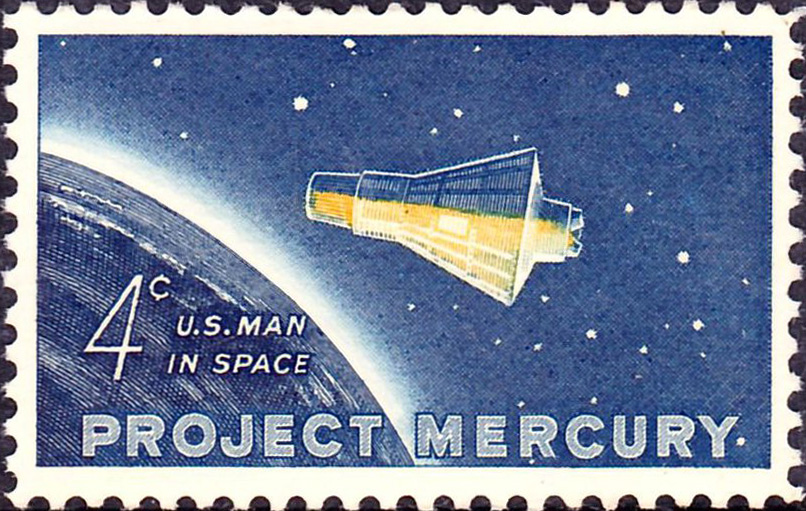
The next Saturday morning, I was in line at the post office with my four cents to purchase a first-class Project Mercury stamp.
Watching the Space Race: Going Ape
Posted by
Karina Fabian
|
Labels:
apes in space,
ham the chimpanzee,
history of american space,
space race history,
the space race,
walt staples
by Walt Staples
The monkey glared down at me with the sort of naked hatred one primate can only feel for another. Were I him, I'd have felt pretty much the same. Torn from his nice toasty jungle at an early age, he now found himself constantly chilly and confronted by a troop of primates so outsized that even the smallest outweighed him by a factor of seven. Basically, Ivan Denisovich in Brobdingnag. But, he held his own; whenever one of them came near, he bared his teeth. If that didn't stop them, he'd set forth a scream that guaranteed that all the dogs and cats would immediately evacuate the house and yards. His final line of defense was to attempt to find an appendage on one of the brutes small enough to get in his mouth. The only thing he wanted was to be gone. By the second month after my usually level-headed uncle had picked up the prisoner at the Sears and Roebuck catalog store in Staunton and brought him to the dairy farm as a Christmas present for his six-year-old daughter, he was sorely in agreement with that ambition. Among my uncle's brothers, the betting was equal money between the escape involving a firearm or a loosened chain followed by some lucky predator. As it turned out, winter in Virginia's Shenandoah Valley ended the tragedy.
All of which explained my shock at the photo in the Washington Star of a chimpanzee apparently cordially shaking the hand of a sea captain. The captain displayed no tooth marks or bandages, and the ape looked pretty relaxed. Of course, shaking a captain's hand was probably a relief after what he'd just been through.
| Chimpanzee Ham is greeted by recovery ship Commander after his flight on the Mercury Redstone rocket. Photo from Wikipedia. |
Throughout most of history, lesser beings have generally been tasked with being the first to try something new, whether it was seeing if the dinner at the Borgia's was up to standards or if there really were Zulus hiding around the spring. The space program was no different. As enlisted men could no longer be pilots, other primates went into space first.
The first tests involving animal payloads began with the U.S. Army's launch of domesticated V2s (read: captured from the Third Reich and demilitarized) in the late 1940s. One of the things learned from these flights was that mammals could survive spaceflight. Another thing learned was that mice are a lot more resistant to a sudden stop at the end of the flight than primates. All of the primates on these missions were named “Albert” (probably for the same reason animals raised for the table tend to be anonymous—you don't name your breakfast).
Over on the other side of the hill, the Soviets preferred dogs as passengers. Not having opposable thumbs, the feeling was that they tended to be less trouble to deal with. There is the story that one of the dogs went AWOL* a day before its scheduled launch. A stray found near the base's canteen was grabbed and substituted (lending a whole new meaning to “dog robber”**). One of the puppies from a dog the Soviets had orbited was given to President John F. Kennedy's daughter, Caroline, during a brief warm spot in the Cold War.
The subject of the photo op with the captain of the recovery ship USS Donner, Ham, was born and captured in Cameroon in 1956 and purchased in Florida by the Air Force. Like Patrick McGoohan in the TV show, “The Prisoner,” Ham's official name was a number, 65, though the staff referred to him as, “Chop Chop Chang.” It was felt that losing a named chimp on a flight would be bad publicity.
He trained for his mission at Holloman Air Force Base. Training involved learning to push a lever within five seconds of seeing a blue light. If he preformed correctly, he received a banana pellet; if he didn't, what's described as a “mild” shock was administered to the soles of his feet. He would be the first biological payload that would be required to preform a function while in flight.
Ham became “Ham” with his successful suborbital flight aboard Mercury-Redstone 2 on 31 January 1961. His new name was an acronym for Holloman Aerospace Medical Center. During the flight, his vital signs and lever pushing were monitored with the result that his functioning was only slowed by a fraction of a second. This suggested that humans could also readily preform tasks during spaceflight. The only untoward happening while in flight was a partial cabin depressurization, which was successfully handled by his space suit. After 16 and a half minutes, the Mercury capsule splashed down in the Atlantic and was recovered by the Donner. On examination, Ham's only injury was found to be a bruised nose. The handshake and photo with the skipper followed.
After the flight, Ham lived at the National Zoo in DC for 17 years before ending his days at age 26 at the North Carolina Zoo at Asheboro. His remains, minus his skeleton, are buried beneath a memorial plaque at the New Mexico Museum of Space History at Alamogordo. His skeleton is in the collection at the Armed Forces Institute of Pathology's National Museum of Heath and Medicine in Silver Spring, Maryland.
The next Mercury capsule would carry Alan Shepard on the first American manned suborbital flight.
* AWOL—Absent WithOut Leave
** ”dog robber”--military slang for an officer's servant, normally called an orderly or batman depending on the army.
Watching the Space Race: High Expectations and Low Comedy
Posted by
Karina Fabian
|
Labels:
mercury mr-1,
NASA,
space race history,
the space race,
walt staples
By Walt Staples
The lights of Deerfield twinkled below as I sat watching the fire. It was the week of deer season west of Blue Ridge and I was counting the days until Thanksgiving that November of 1960. In just three more days, I'd be ten. On the other side of the campfire, Junior glanced at his watch. “Hey, it's about six. Let's go see how the launch went.”
His father, slouched in a lawn chair, said, “You boys go ahead. I'm comfortable.” My father nodded his agreement.
Four of us were in the party that year; me, my father, a friend of his who worked for the government, and the friend's teenaged son, Junior. It had snowed the night after we'd made camp at the spring atop Virginia's Elliott Knob. On the way up to the Knob after seeing my grandmother and uncles, my father had decided that he smelled snow, so we stopped in Craigsville and picked enough groceries to keep us the week.
This deer season was special for me. It was the first in which I was allowed to carry a gun. I carried my father's old Stevens .30-30 bolt-action whose butt stock he'd cut down to fit me. At four foot tall and and about 80 pounds, the Stevens knocked the dust off me every time I fired it, but I figured it'd be worse on the deer's end of the equation. There were a couple of strings attached, though. One of the adults had to be with me and he had to give me the “go” signal before I could take the shot. In preparation before we came down from Northern Virginia, I had had to hit in the target's 10 ring seven out of eight shots. Also, I had to keep all the rifles and shotguns clean.
Inside the tent, Junior pulled the radio from under his cot. It was a special one as it could pick up FM broadcasts in addition to the normal AM, which explained why this small (for its time) radio was slightly larger and much heavier than a boombox. As he snapped it on and we waited for its tubes to warm up, I pulled out the gun cleaning kits, made sure the guns were indeed unloaded, and set to work. After sound began to come out of the speaker, he tuned the radio back and forth until a rich voice said, “...Evening, this is Douglas Edwards with the news. At Cape Canaveral today”--he had our whole attention--”the Mercury-Redstone test did not launch due to technical difficulties. The capsule's escape tower did, however, successfully attain an altitude of some 4000 feet. NASA reports technicians are examining the Redstone booster as we speak. It is expected that this will move the suborbital test launch of the unmanned Mercury capsule into December. In other news, UN troops clashed with Congolese government forces in Leopoldville...” Junior and I looked at each other—huh? The rocket didn't launch but the escape tower worked?
*
The technicians at Canaveral were indeed examining the Mercury-Redstone, MR-1, but from a very long distance. A very long, safe distance. The reason for their standoffishness was that they had a fully fueled booster rocket sitting on the pad with live batteries and live explosive devices just waiting to make a very spectacular fireworks display.
Until 7 November 1960, MR-1 had been fully two days ahead of schedule. This alone should have had people rubbing rabbits' feet and watching for incoming asteroids. It is an old engineering truism that if things are moving smoothly, you're probably missing something. What the folks at Huntsville and the Cape were missing was that the MR-1 Redstone with its increased tankage and the capsule weighed more than a normal Redstone. Possibly, they were lulled when things seemed to return to normal with the scrubbing of the 7 November launch because of a drop in helium pressure within the capsule control system. After removing and tearing down the capsule to replace a helium relief valve and hydrogen peroxide tank, and to redo some wiring, the bird was reassembled and readied for launch on 21 November.
Well, it launched...sort of. When ignition occurred, the MR-1 rose majestically to an altitude of approximately 4 inches (10 cm) and the engine cut off. The bird settled back on the pad, no doubt with a thud (with all the racket of the Rocketdyne A-7 engine's initial firing, this, mercifully, was drowned out). The escape tower's engines fired next and the tower, leaving the capsule--that it was supposed to lift to safety--firmly in place atop the booster, rose to 4,000 feet (1,219 meters) and traveled 400 yards (366 meters) downrange—the epitome of “suborbital.” A few seconds later, the cover of the capsule's parachute compartment flew off and the drogue chute deployed, followed by the main chute and, then, the reserve chute; the three of which draped fashionably down over the side of the capsule and booster. Potentially, the entertainment wasn't over yet, as sitting atop 20 tons (18,160 kg) of liquid oxygen, ethyl alcohol—aka: ethanol—and hydrogen peroxide (a unfriendly mix at the best of times) were live retro rockets, explosive bolts, and a number of other pyrotechnic devices outlawed for 4th of July festivities, in addition to fully charged batteries in the ungrounded booster. Piling on yet more joy, the innocent parachute trio hanging over the side, if caught by the wind would topple the booster-capsule combination with unpleasant results. Happily, for Wernher von Braun and the NASA crew, Flatus, German god of winds, apparently relented and the airs stayed calm.
The next morning, when the batteries hopefully were exhausted, an extremely brave team led by Walter Burke of McDonnell Aircraft Corporation—builder of the capsule—disarmed the pyrotechnics and removed the hanging umbilical cord from the ungrounded rocket.
So, what caused NASA's shortest flight? When the Redstone's engine fired and the rocket began to lift, it moved slower than the original Redstone missile because it was heavier. A modified, too-long ground (another account says “control”) cable pulled out before the umbilical was pulled away. This caused a relay to trip as the ground plug came out more slowly than on the earlier missile, shutting down the engine. At shutdown, the escape tower thinking that the rocket had reached its normal engine shutoff altitude, blew its explosive bolts and jettisoned itself as no longer needed. The capsule getting an abort message below 10,000 feet (472 meters) began its proper parachute deployment sequence. So, for want of a nail—or in this case, a proper-lengthed cable--NASA ended up with a wrinkled rocket, an altitude record it really didn't want, and egg on its face.
The next effort, MR-1A, involved a Frankenstein's monster made up of parts cannibalized from future missions. As the capsule was undamaged, it was mated with the escape tower from spacecraft number 8, and the antenna fairing from number 10, and seated atop a new booster, MR-3. The MR-1 booster was shipped back to the Huntsville shop and now receives visitors at the Marshall Space Flight Center.
Subscribe to:
Posts (Atom)