

NASA has removed ATK Liberty Launch from the shortlist of potential carriers of crew to the ISS because of concern over the technical matters. According to William Gerstenmaier, associate
administrator for NASA’s Human Exploration and Operations Mission Directorate, the problem was that they didn't provide enough details to reassure NASA of the safety of their planned vehicle. ATK did not commetn to Space News about this, and there's nothing about it on their website that I could find. I hope that they will be able to recover from this and re-propose their plans. If not...that's one good thing about this kind of contract system--instead of the government being stuck helping fund a program to make it work, it can choose the ones that are effective. Right now, SpaceX and Boeing are forging ahead. read more here: http://spacenews.com/civil/120904-nasa-dropped-atk-comm-crew.html
Good news for Florida workers in teh space industry: XCOR plans to manufacture and launch its suborbital ships our of Kennedy Space Center. They're taking over some of the old Space Shuttle facilities for its Lynx vehicle. The Lynx willfly tourists, researchers adn payloads into suborbital space (about 100 kilometers, although they intend to later move on to orbital vehicles. They'll be doing test flights of the Lynx Mark 1 in 2012, and plan to build and fly the Linx Mark 2 from Florida in 2014. Right now, the company is stationed in the Mohave, CA, but are moving research to Texas and building and flight to Florida. the comany said they might leave some operations and test flight activities in California. Why the move? Money--the other states provided better incentives and better business conditions. Read more here: http://www.universetoday.com/96987/xcor-to-move-operations-near-kennedy-space-center/
Meanwhile, Back at NASA/KSC


Planetary Resources--Asteroid Mining Becoming Reality
I'm a little behind the curve on this one, but in April, Planetary Resources announced its creation and its mission to start a mining operation on asteroids in near Earth orbit. (Near Earth objects are .98 to 1.3 AUs from the Sun; and AU being the distance between the earth and the sun.) They intend to mine these asteroids for precious metals--primarily platinum and palladium, which will give the best return on investment--and for water, which is one of the most useful resources for earth and space.
This is going to be a long-term project running, no doubt, into the billions of dollars before it bears fruit. Good thing there are some extremely rich people with vision to set it in motion: director James Cameron (net worth approx $700 million) and Google co-founder Larry Page (net worth 16.7 billion). Say what you want about the "one percent," but it's the one percent with vision and ambition that will fund what we aspire to--and when they succeed, we will all benefit in things like cheaper medical equipment and automobile fuel cells. How? "A single platinum-rich space rock 1,650 feet (500 meters) wide contains the equivalent of all the platinum-group metals ever mined throughout human history," company officials said in an article in Space News. (Learn more about platinum applications here: http://www.platinum.matthey.com/applications/)
In the meantime, they have several steps to take, many of which will mark firsts in commercial space, like the launch of the first private space telescope in low earth orbit to seek out potential asteroids. They will also need to develop inexpensive robotic probes to check out the asteroids, and then of course, mining robots. You can read about their process here. http://www.planetaryresources.com/technology/
I love what they say in the beginning: "With technological advances that are coming out of exponential technologies and investors willing to bear the risk, small teams are now able to do what only governments and large corporations can do before." That's what makes this centruy so exciting to live in.
I am definitely a fan of Planetary Resource's vision and mission. I'll be watching to see how well they can make it a reality.
Dragon Launch Delayed
 |
| Anticipation...anticipa-a-tion. It's making me wait. |
SpaceX announced this week that it wants to delay the planned Feb 7 launch of its Dragon capsule in order to conduct more tests. It will work with NASA to determine the next best launch date.
This will be a big launch for the Dragon. Consider:
* It will make history as the first commercial capsule in space.
* It will determine if SpaceX continues to get NASA funding to further its development.
* It's the next step to making the Dragon ready for manned flights.
* If the Dragon succeeds, we will once again have US ability to resupply the space station.
In addition, they are combining two test flight missions into one, which increases the difficulty--and the pressure. The Dragon must pass several objectives before it's allowed to approach the International Space Station. Before docking with the station, it will do a fly-by to test sensors and control. Then, if it passes all that, it will dock.
A written statement, quoted in several news sources, says that SpaceX believes the capsule will benefit from the further work, which will increase safety. That should go without saying. SpaceX has had good record of success, overall, but they have had some problems even in successful test launches before. (From Forbes, May 2011: "Both launches of the much bigger Falcon 9 vehicle last year were successful, they point out — which is crucially important, since that is the rocket that SpaceX plans to use for supplying the space station. However, two launches isn’t much of a track record, and those launches were far from flawless. For instance, the trade press reported after the initial Falcon 9 launch in June of last year that “roll torque” from the first stage engines had produced a “twisting motion” on lift-off, that an overheated actuator had caused “dramatic spin” in the second stage, and that restart of the second-stage engines did not occur as planned.")
It's not known (at least to any sources I could find) whether the delays are for testing of the Falcon 9 launch vehicle or the Dragon itself. However, it's not unusual to slip a launch to be sure the equipment is ready.
I'm disappointed--I was looking forward to the flight, and now we have to wait some more! However, if it's the difference between success and catastrophe, We'll wait a little longer.
For more, check out http://www.nasaspaceflight.com/2012/01/dragon-slips-spacex-determined-return-us-crewed-access-leo/.
...and speaking of shortsighted governments
The new budget for NASA has significantly cut commercial space...and our chance to spend American dollars on American space industries and get our-ownselves into space.
 |
| No, I'm not frustrated. Why do you ask? |
 |
| You don't want these! |
 |
| Trust me: These are going to do you good later. |
 |
| The re-entry capsule of Shenzhou-. Congrats to the Chinese. 祝贺 |

But looking beyond that, let's consider what it will cost the US to keep sending astronauts to the ISS on the Soyuz: just $47 million a seat. Remember SpaceX believes they can do it for $20 million. Even if they have cost overruns, they'll be cheaper. But not if we don't get there.
So, the question is, will NASA delay programs in hopes of getting better budgets later, cut out some of the competition and concentrate on the companies that are closest to success, or do a "peanut-butter spread" cut and make all the programs suffer. Or maybe Congress will make a bill to give special funding later. I've not found anything yet, so stay tuned.
Industry Profile: Orbital Sciences Corporation
Time to give a different company some space on the blog. (Pun intended, of course.)
Unlike SpaceX, Orbital (also known as Orbital Sciences Corporation) has been around for a long time, and has done some pretty innovative stuff. Space geeks of my generation will remember how cool the Pegasus launch system was--the rocket actually launches from an airplane.
Orbital has mostly been concentrating on the small-to-medium satellites. Thier larger missiles are a combination of Pegasus boosters and old ICBM missiles--the Minuteman II and Peacekeeper. (See? the government CAN recycle!)
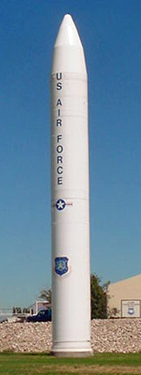 |
| More than a memorial lawn ornament to the Cold War Era. (Actually, they just use the engines.) |
 |
It's patterned after the existing multi-purpose Logistics Modules used on the space station. (Orbital seems big on using existing technologies approved by the government. Not a bad angle if you're looking for government contracts.) They have a COTS contract with NASA for resupply operations between 2012 and 2015 and the Cygnus is supposed to be crew capable. (They didn't say on their website directly, but reading between the lines, they'll use a launch abort system similar to the one they designed for the Lockheed-Martin Orion capsule.)
Orbital is a small but strong company with 3700 employees, 1800+ or which are engineers. They're located in Arizona (manufacturing), California (launch) and the DC beltway (admin.) Their website is http://www.orbital.com.
So, what do you think? How do they compare to SpaceX, in your opinion? What else would you like to know about them? Let's start a discussion!
Space Industry Profile: SpaceX, part 2
Hey, readers--what do you want to know about these emerging industries? I can give you the stuff I find interesting, but I'd like to hear from you!

In the meantime, let's talk a little more about SpaceX.
As I mentioned in my first blog about this company, it was founded in 2002 and in just nine years has created three successful rockets--Falcon 1 and Falcon 9 (so named because it has nine engines) and the Falcon Heavy and is working on a capsule, called the Dragon, that will provide material resupply and later manned missions to the ISS (and other stations as they may appear.) Incidentally, due to the problems with the Soyuz this fall, they will not get to test fly the Dragon to the ISS until at least sometime in December (according to a schedule updated online on Oct 14), although some sources are saying it could be January. They are also working on meeting NASA requirements to make the Dragon manned-approved; basically, they want an escape system for the astronauts in case they have to abort after launch.
SpaceX isn't just depending on NASA for its income, of course, They already have contracts with the Air Force and with other companies and nations to provide launch capability--mostly satellites, of course. They are also looking for new ways to push the barrier. the first is looking at reusable rockets, which I blogged about Oct 7. Of course,t he founder, Elon Musk, says he has grander ideas than even that. He wants to go to Mars--not just to explore and certainly not to plant flags, but to start a viable community--one he can retire to!
 |
| Living the dream! And get off my, er, lawn! Photo from Mars Society, I believe--the article I got it from didn't say, but it does talk about plans to colonize Mars from a 2009. |
OK. so that's going to take a lot more than a rocket, but getting there is half the battle. (For the record, if Musk succeeds, Rob is going to be at me insufferably to retire to Mars, I can see it coming. He's already got that gleam in his eyes that says, "Making history...living in SPACE...no yardwork... It's ALL GOOD!")
I really enjoyed the article about Musk's retirement plans (which constituted the headline but not the whole article) because it also gave some insight into the working environment. Take a guess: Knowing that SpaceX has created and launched three rockets, one to rival the Saturn Five, which took us to the moon, is farthest ahead in the "race" to send men to the ISS, and is thinking Mars missions...how many people work at this company?
A little over a thousand, mostly at their Hawthorne, CA factory. I'm impressed that a thousand people did what some nations haven't been able to do! Of course, with success, contracts and big dreams, they're growing--check out the jobs list if you want to dream.
I have found a few negatives about SpaceX in the news. Some say it's riding on the force of Elon Musk's personality and fortune (lots of "Tony Stark" imagery there), and that they are biting off more than the company can financially chew--that they are developing technologies there isn't really a market for yet. I have seen that argument applied to the space industry as a whole. They look at the satellite boom-and-bust where in the 90s, it was thought that thousands of satellites would be going into orbit in the next decade in order to support cell phones, but when cell phone towers sprang up instead, many companies that were preparing for those assumed launches died.
I do believe that may happen, especially with some of the companies that depend solely on NASA to get their start or who are not contracting outside customers. It will take more than a few tourists and the ISS to keep a company alive. So far, SpaceX seems to have a good head on its shoulders. While its launch manifest is heavy on NASA flights, it does have several other customers slated through 2017.
Here's one thing I like about SpaceX--and indeed, about commercial space as opposed to government-controlled space industry: Even though SpaceX is looking at these new technologies and long-long term goals, they are not abandoning their current path, but working both simultaneously. Frankly, they have to--they lack the "luxury" of governments to change their mind with every administration or change budgets, focus, etc.
OK. What more do you want to know about SpaceX--or shall I move on to a new company?
Shuttle Moves Out; Others Move In
Once a week, I plan on summarizing a current event article about space. Since we were talking about the industry still being alive and well, I thought this article fit nicely: "At Florida Spaceports, Commercial Operators Prepare To Move In," Space News, August 19, 2011.
 |
| Ground breaking ceremonies for SpaceX’s new Falcon 9 rocket launch facilities at Space Launch Complex 40, Cape Canaveral, Florida. (from left) Thad Altman, Florida State Representative; Jeff Kottkamp, Florida State Lt. Governor; Elon Musk, Founder and CEO, Space Exploration Technologies; Brigadier General Susan Helms, Commander, 45th Space Wing, United States Air Force; Lynda Weatherman, Brevard County Economic Development Commission CEO/President; Steve Koehler, President of Space Florida; Janet Petro, Deputy Director NASA Kennedy Space Center; Patricia Grace Smith, FAA Associate Administrator for Commercial Space Transportation; Steve Cain, NASA Kennedy Space Center COTS project manager. Credit: Jim Campbell, Aero-News Network. Photo and names taken from SpaceX website. |
Space X is setting up housekeeping at Cape Canaveral, upgrading an old Delta II processing hanger to launch thier Falcon Nines. They've renamed it Hangar X. (Got a theme going.) They'll also tune up a payload processing and integration facility for the Dragon capsule. They have a goal of launching 12 rockets a year by 2015. That's pretty ambitious, not just for the logistics but also finding the business. But how cool would that be?
There's also talk of Boeing taking up residence in some of the facilities to service their own Crew Space Transport capsule. (They need naming lessons from SpaceX.)
So while the Shuttle program has ended, new programs begin. The question is now: How soon, folks? How soon until Cape Canaveral is launching humans again?
What am I doing and why?
(Just a note: I have no idea how to remove that box and "Undefined" interfering with the title. I downloaded this awesome shell, so if any HTML guru knows how to fix it, I'll be your BFF!)
Welcome to Rocket Science for the Rest of Us. (Thanks, Becca Butcher for the excellent title!) This blog is going to be a mad, ADD-style mishmash of layman-level articles about the space industry--everything from weekly news to how a VASIMR rocket works to some sci-fi. If I can, I'll get some interviews from folks in the industry, too. I plan on posting at least once a week; more if something excites my interest.
My friends who know me probably wonder why in the 'verse I'd even consider making a new blog. I'm always at least writing a book, editing another, teaching classes, working for the CWG, marketing my books--and then there are the four children who are the stars of my life and my incredibly brilliant, loving and patient husband, Rob.
I'm going to sound hopelessly old-fashioned here, but Rob is the main reason I'm doing this. He's coming to the end of his military career, and rather than seeing it as an end, he's seeing the exciting new beginning. He's worked military space and missiles; now he's ready to fulfill his dream of being part of the movement to get Man in space--and he sees that promise in the commercial space industry. I share his interest and excitement, but I do not share his knowledge--my focus has been elsewhere. I know enough to have light conversation and to ask intelligent questions, but I'm not satisfied with doing that anymore. Also, while I feel absolutely no pressure to "talk shop" with other officers when we go to functions on base, I do want to be able to hold conversations with folks at SpaceX or Bigelow that go beyond, "This is so cool!" or "Hi! I write about dragons." I want to be the arm candy that talk space.
